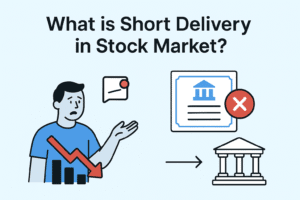
When you buy or sell shares in the stock market, the exchange ensures that both sides are settled smoothly. But sometimes, the seller fails to deliver shares to the exchange on settlement day.
This situation is known as short delivery.
Short delivery affects both buyers and sellers, and the exchange follows a strict process to complete the transaction using an auction.
This article explains:
✅ What short delivery means
✅ Why short delivery happens
✅ What happens to buyers
✅ What happens to sellers
✅ Auction process in simple terms
✅ Examples to understand clearly
✅ Penalties involved
What Is Short Delivery?
Short delivery happens when the seller does not or cannot deliver the shares to the exchange on the settlement day (T+1).
This usually occurs due to:
Sellers shorting a stock intraday but unable to buy it back
Stocks hitting upper circuit (no sellers available)
Delivery shortage due to low liquidity
Human errors such as selling stocks that are not available in your demat
When this happens, the exchange steps in and conducts an auction to procure shares for the buyer.
Short Delivery: What Happens to the Buyer?
How do you know if short delivery has occurred?
Most brokers send alerts such as:
Email or app notifications
A “short delivery” or “SD” tag beside the stock
Delay in receiving shares in your demat
When does the buyer receive shares?
Here’s the timeline in a simple explanation:
Let’s assume:
You buy 40 shares of XYZ Ltd. on Monday (T Day).
Normal settlement cycle is T+1 (shares should reach by Tuesday).
But the seller fails to deliver on Tuesday (T+1).
Here’s what happens step-by-step:
Step-by-Step Buyer Timeline
Monday — T Day
You buy 40 shares.
Shares appear as “T1” holdings.
Tuesday — T+1 Day
Exchange checks whether the seller delivered the shares.
The seller fails to deliver, so the trade goes into short delivery.
You see a short delivery tag on the stock.
Wednesday — T+2 Day
Exchange conducts an auction to buy 40 shares from another seller.
Thursday — T+3 Day
Successfully auctioned shares are delivered to your demat account.
You can now sell/use the shares normally.
If the exchange cannot buy shares in the auction
You get cash compensation instead:
Close-out price =
Highest price of the stock from T to T+2 + 20% extra penalty
This protects the buyer.
Short Delivery Example for Sellers
Let’s assume:
You sell 100 shares of ABC Ltd. at ₹600 on Monday (T Day).
However, you do not have the shares in your demat account, or the stock hits an upper circuit, so you can’t buy back.
This results in short delivery.
Step-by-Step Seller Timeline
Monday — T Day
You sell 100 shares @ ₹600.
Tuesday — T+1 Day
Exchange tries to take delivery from you.
You fail → trade goes for auction.
Wednesday — T+2 Day
Auction is conducted.
Suppose the T day’s close was ₹620.
Auction price band =
₹620 ± 20% = ₹496 to ₹744
Shares purchased in the auction @ ₹700
The exchange buys at ₹700 and delivers to the buyer.
Seller Loss Calculation
You sold at ₹600, but the exchange bought at ₹700.
Loss = (₹700 – ₹600) × 100
= ₹10,000 debited from the seller’s account
Auction Penalty Calculation
Exchange also charges:
Penalty = 0.05% × (Settlement value)
Settlement value uses the previous closing price (₹620):
= 100 shares × ₹620
= ₹62,000
Penalty = 0.05% of ₹62,000 = ₹31
GST @18% = ₹5.58
Total penalty = ₹36.58
This is small compared to the auction loss.
Important Things to Know About Short Delivery
1. Auction price is unpredictable
It may be much higher than the selling price.
2. If auction price is lower than the T-day closing price
The exchange uses the higher closing price to protect buyers. The difference goes to the Investor Protection Fund (IPF).
3. Exchange charges a 1% facilitation fee
This is added to the auction settlement value.
Why Short Delivery Happens
Some common reasons:
Intraday short selling and failing to square off
Stock hitting upper circuit
Low liquidity
Not having enough shares in demat
Demat account issues or mismatched ISIN
Technical failure or order mismatch
How to Avoid Short Delivery (For Traders)
Avoid shorting illiquid stocks
Don’t short stocks with a history of delivery issues
Ensure you have stocks in your demat before selling
Avoid trading on days with high volatility
Always check margin requirements before placing orders
Conclusion
Short delivery is rare but can happen during high volatility or low liquidity.
Buyers receive shares with a delay (or cash compensation).
Sellers face auction penalties and must pay the price difference.
Understanding the settlement cycle and risks helps traders avoid unexpected losses.



Pingback: Compare Brokers
Pingback: Compare Brokers