Options trading often sounds exciting. Many traders are drawn to it because of stories about quick profits, limited capital requirements, and high leverage. But behind this excitement lies risk—sometimes much more than beginners expect.
If you are new to the stock market and trying to understand options trading, one of the first questions you will face is:
Is option buying safer than option selling, or is it the other way around?
In this blog, we will break down:
What options are
What option buying and option selling mean
The risks involved in both strategies
Simple real-life examples to help you understand
Which approach suits beginners better
This guide avoids technical jargon and focuses on clarity, so even first-time traders can follow along easily.
What Are Options? (In Simple Words)
An option is a contract that gives you the right, but not the obligation, to buy or sell a stock (or index) at a fixed price on or before a specific date.
There are two main types of options:
Call Option – Used when you expect prices to go up
Put Option – Used when you expect prices to go down
Options always have an expiry date, after which they become worthless.
Now let’s understand the two main ways people trade options.
What Is Option Buying?
When you buy an option, you pay a small amount called a premium to purchase the right to buy or sell something later.
Think of option buying like booking a movie ticket in advance. If you go to the movie, you enjoy it. If you don’t, the ticket money is lost—but nothing more than that.
Key Features of Option Buying
You pay a fixed premium upfront
Your maximum loss is limited to that premium
Profit potential can be large
Time works against the option buyer
Risks in Option Buying
While option buying is often considered safer for beginners, it is not risk-free.
1. Limited Loss, But Loss Is Common
The biggest advantage is also its biggest reality:
You can lose 100% of the premium paid
If the market does not move in the direction you expected before expiry, your option can expire worthless.
Many beginners repeatedly lose money because:
The stock moves slowly
The move happens too late
The market stays flat
2. Time Decay Hurts Buyers
Options lose value as expiry approaches. Even if the stock price doesn’t move against you, your option can still lose value every day.
This is why many option buyers feel frustrated when:
“The stock didn’t fall, but my option price still went down.”
Example: Risk in Option Buying
Suppose:
NIFTY is at 22,000
You buy a Call Option for ₹100 (premium)
Worst-case scenario:
The market doesn’t go up
Option expires worthless
Your total loss = ₹100
No matter what happens, you cannot lose more than ₹100.
What Is Option Selling?
Option selling is the opposite side of the trade.
When you sell an option, you receive the premium upfront. In return, you take on the obligation to fulfill the contract if the buyer exercises it.
Think of option selling like renting out your house. You receive rent regularly, but if something goes wrong, repairs can be expensive.
Key Features of Option Selling
You receive premium upfront
Profit is limited to the premium received
Loss can be very large
Requires margin and discipline
Risks in Option Selling
This is where things get serious. Option selling carries higher risk, especially for beginners.
1. Unlimited Loss (In Some Cases)
When selling:
Call options can have unlimited loss
Put options can have very large losses
If the market moves sharply against your position, losses can grow rapidly.
2. Margin Calls and Forced Losses
Option selling requires margin money. If the market moves against you:
Broker may ask for additional funds
If not provided, positions may be force-closed at a loss
This often happens suddenly, leaving traders shocked.
3. Emotional Pressure
Option sellers face:
Stress from sudden market moves
Fear of overnight gaps
Constant monitoring of positions
This emotional pressure makes it difficult for beginners to manage trades calmly.
Example: Risk in Option Selling
Suppose:
NIFTY is at 22,000
You sell a Call Option and receive ₹100 premium
Best-case scenario:
Option expires worthless
Your profit = ₹100
Worst-case scenario:
NIFTY rises sharply to 22,500 or beyond
Loss increases with every point move
Loss can be several times more than ₹100
This is why option selling is often described as:
“Small profits, big risks.”
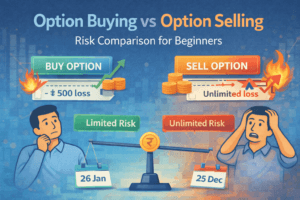
Option Buying vs Option Selling: Risk Comparison Table
| Aspect | Option Buying | Option Selling |
|---|---|---|
| Maximum Loss | Limited (Premium paid) | High / Unlimited |
| Maximum Profit | High | Limited (Premium received) |
| Margin Required | Low | High |
| Stress Level | Lower | Higher |
| Suitable for Beginners | Yes | No (without experience) |
| Time Effect | Against buyer | In favor of seller |
Which Is Riskier: Buying or Selling Options?
From a pure risk perspective:
Option selling is riskier than option buying
Losses in selling can be sudden and large
Buying options limits losses but increases probability of small losses
That said:
Option buying loses frequently but in small amounts
Option selling wins frequently but loses big when wrong
Both require proper understanding, but beginners should never jump into option selling without risk management knowledge.
Common Beginner Mistakes
Many new traders:
Start option selling after seeing others earn premium
Ignore stop losses
Overtrade with large quantities
Don’t understand margin requirements
These mistakes often result in heavy losses and loss of confidence.
Which Strategy Is Better for Beginners?
For beginners:
Option buying is safer
Losses are predictable
Capital requirement is low
Risk is controlled
However, even option buying requires:
Correct market direction
Timing
Proper position sizing
Option selling should only be attempted when:
You understand margin and risk
You use hedging strategies
You can handle volatility emotionally
Final Thoughts: Understand Risk Before Trading Options
Options are powerful financial instruments. They can help you manage risk, generate income, or speculate—but only when used correctly.
Before choosing between option buying and option selling, remember:
Limited loss does not mean guaranteed profit
High probability trades can still cause big losses
Knowledge and discipline matter more than strategy
If you are new to options trading, focus on learning first, trading small, and protecting capital. Understanding risk is not optional—it is essential.