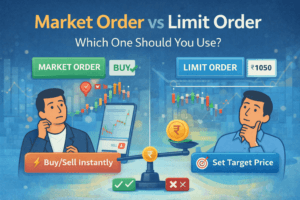
If you are new to stock market trading, one of the first things you’ll notice while placing a trade is that you are asked to choose an order type. Two of the most common options are Market Order and Limit Order.
At first glance, these terms may sound confusing, but don’t worry. Understanding the difference between market orders and limit orders is much simpler than it seems—and learning when to use each one can significantly improve your trading experience.
In this blog, we’ll break down both order types in plain language, explain their advantages and disadvantages, and share practical examples so you can confidently decide which one suits your trading style.
What Is a Market Order?
A market order is the simplest type of order in trading. When you place a market order, you are telling your broker:
“Buy or sell this stock immediately at the best price available in the market.”
You do not specify the price. The order gets executed instantly at the current market price.
Example of a Market Order
Suppose the share price of Company ABC is currently around ₹500.
You place a market buy order
Your order is executed immediately
You may get the stock at ₹500, ₹501, or even ₹499, depending on market demand and supply
The key point is speed—your trade happens right away.
Advantages of Market Orders
Market orders are popular because they are simple and fast. Here’s why traders use them:
1. Instant Execution
Market orders are executed immediately, which is useful when you don’t want to miss a trade.
2. Easy for Beginners
There is no need to analyze price levels. You just click buy or sell.
3. Useful in High Liquidity Stocks
For stocks with heavy trading volume, price fluctuations are usually small, making market orders relatively safe.
Disadvantages of Market Orders
Despite their simplicity, market orders come with risks:
1. No Price Control
You have no control over the price at which your order is executed.
2. Price Slippage
In fast-moving or volatile markets, you may get a price very different from what you expected.
3. Risky in Low Liquidity Stocks
If there are fewer buyers or sellers, your order might execute at an unfavorable price.
What Is a Limit Order?
A limit order allows you to set the price at which you want to buy or sell a stock.
For buy orders, you set the maximum price you are willing to pay
For sell orders, you set the minimum price you are willing to accept
The trade will only execute if the market reaches your specified price.
Example of a Limit Order
Let’s say Company XYZ is trading at ₹1,000.
You want to buy it only if the price drops to ₹980
You place a limit buy order at ₹980
Your order executes only if the price touches ₹980
If the price never drops, the order remains pending or expires.
Advantages of Limit Orders
Limit orders are preferred by traders who want better control.
1. Full Price Control
You decide the exact price at which you want to trade.
2. Avoids Overpaying or Underselling
This is especially useful during volatile market conditions.
3. Ideal for Disciplined Trading
Limit orders help traders stick to predefined strategies and avoid emotional decisions.
Disadvantages of Limit Orders
Limit orders also have some limitations:
1. No Guaranteed Execution
If the market never reaches your price, your order won’t be executed.
2. Missed Opportunities
Sometimes, the price moves quickly and never comes back to your limit price.
3. Requires Patience
Limit orders are not suitable if you want immediate execution.
Market Order vs Limit Order: Key Differences
Here’s a simple comparison to help you understand better:
| Feature | Market Order | Limit Order |
|---|---|---|
| Execution Speed | Immediate | Depends on price |
| Price Control | No | Yes |
| Risk of Slippage | High | Low |
| Best For | Urgent trades | Planned trades |
| Beginner Friendly | Very easy | Slightly advanced |
When Should You Use a Market Order?
Market orders are best used in the following situations:
1. Highly Liquid Stocks
Large-cap stocks with high trading volume usually have minimal price slippage.
2. Urgent Trades
If you need to enter or exit a position quickly, market orders make sense.
3. Small Trade Sizes
For small quantities, price differences are usually negligible.
When Should You Use a Limit Order?
Limit orders work best when:
1. Market Is Volatile
During high volatility, limit orders protect you from unexpected prices.
2. You Have a Target Price
If you have done analysis and know your entry or exit price.
3. Swing or Positional Trading
Traders who hold positions for days or weeks prefer limit orders.
Practical Trading Scenarios
Scenario 1: Long-Term Investor
If you’re investing for the long term and buying a fundamentally strong stock, a limit order helps you buy at a better valuation.
Scenario 2: Intraday Trader
If timing is crucial and you want instant entry or exit, a market order is often preferred.
Scenario 3: Stop-Loss Execution
Many traders use market orders for stop-loss execution to ensure they exit the trade without delay.
Common Mistakes Beginners Make
Using market orders in low-volume stocks
Placing limit orders too far from the market price
Ignoring market volatility
Not understanding order execution rules
Avoiding these mistakes can save you from unnecessary losses.
Final Thoughts: Which One Should You Use?
There is no “better” order type—it all depends on your trading goal, market condition, and risk tolerance.
If speed matters, choose a market order
If price matters, choose a limit order
If you’re unsure, start with limit orders to stay disciplined
As a beginner, understanding these basics will give you a strong foundation and help you trade with confidence rather than confusion.
Pro Tip for New Traders
Before placing real trades, practice using market and limit orders in a paper trading or demo account. It’s the safest way to learn without risking real money.