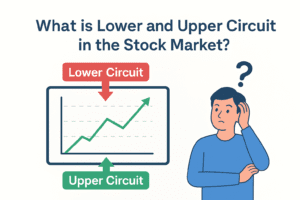
 If you are a trader or investor in the Indian stock market, you must have come across the terms upper circuit and lower circuit. These phrases usually become popular when a stock is rising extremely fast or falling sharply. You may have also seen news headlines saying, “XYZ stock hits upper circuit” or “ABC stock locked in lower circuit.”
But what do these terms actually mean? Why do they matter? And how do they protect investors?
In India, upper circuits and lower circuits are essential safety mechanisms used by stock exchanges to control unusually high volatility. They help maintain market stability by preventing extreme price fluctuations in a single trading session.
In this blog, we will break down everything you need to know in simple, easy-to-understand language:
What is upper circuit?
What is lower circuit?
How do circuits work?
Why are they important for investors?
Real-world examples
Practical tips
What triggers circuits?
Let’s get started.
2. Definition of Lower and Upper Circuits
Upper Circuit Meaning
The upper circuit is the maximum price limit a stock is allowed to reach during a trading session.
This limit is fixed by the stock exchange to prevent excessive and uncontrolled price rise.
For example:
If a stock is trading at ₹100 and the exchange sets a 10% upper circuit, the stock cannot go above ₹110 on that day.
Once it touches ₹110, trading for that stock may freeze because there are only buyers and no sellers.
Why does an upper circuit occur?
An upper circuit usually indicates:
Strong bullish sentiment
Heavy demand for the stock
Positive news or developments
Speculation or momentum trading
Low supply of shares
When buyers outnumber sellers significantly, the stock hits the upper price band.
Lower Circuit Meaning
The lower circuit (also called the lower price band) is the lowest price a stock is allowed to fall to during a trading session.
Continuing the earlier example:
If the stock is at ₹100 and has a 10% lower circuit, it cannot go below ₹90 for the day.
Once the stock hits its lower circuit, there are usually only sellers and no buyers, and trading may freeze.
Why does a lower circuit occur?
A lower circuit indicates:
Panic selling
Negative news or results
Loss of investor confidence
Market-wide volatility
Fear-driven trading behavior
When sellers heavily outnumber buyers, the stock gets locked in a lower circuit.
3. How Lower and Upper Circuits Work
Circuits are part of a system known as circuit breakers. These limits are put in place by stock exchanges such as NSE and BSE.
How does the circuit mechanism work?
Exchanges set daily price bands
Stocks are assigned limits like 2%, 5%, 10%, 20% based on their volatility and category.If the stock price hits the limit, trading may be:
Temporarily halted, or
Allowed only on certain orders, or
Completely paused until conditions normalize
If volatility continues, extended halts may be triggered.
Why do exchanges use circuit limits?
To avoid manipulation
To reduce panic
To protect retail investors
To maintain market stability
To prevent sudden large losses
Do all stocks have circuit limits?
Not all.
Many F&O stocks do not have strict daily limits because they are highly liquid.
Most mid-cap and small-cap stocks have fixed daily bands like 5%, 10%, or 20%.
4. Importance of Lower and Upper Circuits in Stock Trading
Circuits play an essential role in a well-functioning stock market. Here’s why:
1. Protecting Investors from Extreme Volatility
Sharp unpredictable movements can lead to panic or irrational decisions. Circuits help cool down market sentiment.
2. Preventing Market Manipulation
Some traders try to artificially push prices up or down. Circuits help curb such activities.
3. Ensuring Orderly Trading
Sudden price shocks create disorder in trading activities. Price bands ensure smoother functioning.
4. Allowing Time for Information Absorption
When big news breaks—good or bad—investors need time to analyze it. Circuit halts offer that breathing space.
5. Improving Market Transparency
By stopping extreme movements, the exchanges help traders make better and more informed decisions.
5. Real-World Examples of Lower and Upper Circuits
Example 1: Stock Hitting Upper Circuit
A small-cap company announces excellent quarterly results:
Revenue jumps 40%
Profits rise significantly
The company provides strong future guidance
Investors rush to buy the stock.
Buyers exceed sellers dramatically.
The stock hits the 10% upper circuit, and trading freezes because no one wants to sell.
This often signals high demand—but also potential speculation.
Example 2: Stock Hitting Lower Circuit
Suppose a company faces:
Fraud allegations
Weak earnings
Sudden resignation of promoters
Negative media coverage
Investors rush to sell the stock.
But no buyers are willing to purchase.
The stock hits the 10% lower circuit.
This freeze protects against:
Panic-driven crashes
Manipulative short-selling
Investor losses
Example 3: Market-Wide Circuit Breakers
On extremely volatile days, the entire stock market can hit circuit—for example:
A 10% fall triggers a 45-minute halt
A 15% fall halts trading for 1 hour
A 20% fall ends the trading session for the day
These rules protect the entire market—not just individual stocks.
6. Factors That Trigger Upper or Lower Circuits
Several reasons can push a stock to its circuit limits:
1. Company-Specific News
Earnings results
Mergers & acquisitions
Management changes
Expansion plans
2. Market News or Events
Global economic slowdown
Political instability
Wars and trade disputes
3. Investor Sentiment
Fear and panic
Overconfidence
Herd behavior
4. Low Liquidity
Stocks with low trading volumes are more prone to circuits.
5. Sudden Price Manipulation
Pump-and-dump schemes often push stocks to upper circuits multiple days in a row.
7. How Investors Can Use Circuits Wisely
While circuits are safety tools, investors can use them strategically:
1. Using Stop-Loss Orders
Stop-loss orders help exit before the stock hits lower circuit, preventing major losses.
2. Monitoring Circuit Levels
Checking the stock’s circuit band helps understand:
Volatility
Risk
Supply-demand imbalance
3. Avoiding Herd Mentality
Just because a stock hits upper circuit 3–4 days in a row does not guarantee future returns.
Similarly, a lower circuit does not always mean the company is bad.
4. Doing Proper Research
Always check:
Company fundamentals
Debt levels
Promoter shareholding
Industry status
News and announcements
5. Spotting Opportunities
A stock hitting upper circuit may be a sign of strong positive sentiment.
A stock hitting lower circuit might provide buying opportunities—but only after research.
8. Conclusion
By now, you should have a clear understanding of what upper and lower circuits mean and why they play such an important role in the Indian stock market.
Circuits are essential tools designed to:
Control excessive volatility
Protect retail investors
Prevent manipulation
Maintain stability
However, just because a stock hits an upper or lower circuit does not automatically make it a good or bad investment. These movements reflect an imbalance between buyers and sellers.
Before making any trading or investment decisions, always take time to research the company, understand market conditions, and assess your own risk tolerance. The stock market can be unpredictable, but having knowledge about concepts like circuits helps you navigate it more confidently.