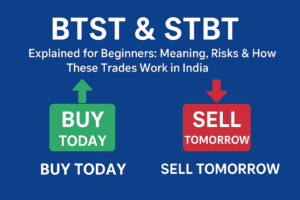
Trading in the stock market introduces new terms and strategies that may seem confusing at first. Two such concepts that many beginners come across are BTST (Buy Today Sell Tomorrow) and STBT (Sell Today Buy Tomorrow). These trading styles revolve around short-term price movements and quick decision-making. But how do they work? Are they safe? And can you actually do STBT in India?
In this detailed beginner-friendly guide, we’ll break everything down in simple language—even if you’ve never traded before.
What is BTST (Buy Today Sell Tomorrow)?
BTST stands for Buy Today, Sell Tomorrow. As the name suggests, it’s a type of trade where you buy shares on one day and sell them the very next market day, before the shares actually get delivered to your demat account.
Why is this possible?
Because in India, the stock market follows a T+1 settlement cycle.
This means:
You buy shares today (T day)
The shares are credited to your demat account on the next working day (T+1)
But BTST allows you to sell shares before they get credited, taking advantage of price movement within that short window.
How Does BTST Work?
Imagine BTST like online shopping.
You order a product today (buy shares).
The product will be delivered tomorrow (shares credited).
But what if someone is willing to buy the product from you before it even reaches your home?
That’s BTST.
Example:
You buy 100 shares of XYZ Ltd. at ₹100 each today.
Tomorrow, XYZ opens at ₹108.
Before the shares even come to your demat account, you sell all 100 shares.
Your profit:
This quick profit is the main reason traders use BTST.
Why Do Traders Use BTST?
Here are the most common reasons:
To take advantage of short-term news or price movements
To sell shares before T+1 and lock in profits
To avoid overnight risk of holding shares for longer periods
BTST is popular among traders who want to benefit from next-day price gaps.
Key Features of BTST
| Feature | Explanation |
|---|---|
| Holding period | Only 1 day (buy today, sell tomorrow) |
| Requires margin? | Yes, depending on broker |
| Shares credited? | On T+1, but sold before that |
| Broker charges? | Delivery brokerage or BTST charges (depends on broker) |
| Risks? | Yes—mainly short delivery risk |
What Are the Risks Involved in BTST?
Like all trading strategies, BTST carries risks. Some traders mistakenly believe BTST is “safe” because of the short holding period—but that’s not true. Here are the main risks, explained in simple language:
1. Risk of Short Delivery
This is the biggest BTST risk.
If many traders are selling a stock and not enough people are delivering it on time, the exchange may not be able to give you the shares you sold. This is called short delivery.
What happens then?
Your trade goes into auction, where the exchange buys shares on your behalf—often at a higher price.
Example of Short Delivery Loss:
You sell shares at ₹108
But shares fail to come to your demat
Exchange buys them via auction at ₹115
You must pay the difference
Loss = (₹115 – ₹108) × number of shares
This is why BTST should be done cautiously.
2. Gap-Down Opening Risk
The price may not always go up the next day.
If negative news comes after market hours, the stock can open lower.
Example:
You buy at ₹100
Next day the stock opens at ₹90
Loss = ₹10 per share instantly.
BTST traders face overnight news risk, similar to delivery traders.
3. Higher Brokerage or BTST Charges
Different brokers treat BTST differently. Some charge:
Normal delivery charges
BTST-specific fees
Higher margin requirements
Always check your broker’s charge sheet to avoid surprises.
4. No Control Over Price Fluctuations
Since BTST depends on next-day movement, even a small gap down can lead to losses.
You cannot prevent overnight market reactions.
Is BTST Good for Beginners?
BTST might sound simple, but it requires understanding:
Market volatility
News-based events
Overnight price gaps
Short delivery risk
It is not automatically safer than intraday or delivery trading.
Beginners should first learn market basics before trying BTST.
Is STBT (Sell Today Buy Tomorrow) Allowed in India?
Short answer: No, STBT is not allowed in the Indian stock market for equity delivery.
Let’s understand why:
What Is STBT?
STBT stands for Sell Today, Buy Tomorrow.
It is the opposite of BTST.
You sell shares today without actually owning them, and buy them back the next day.
This is similar to “short selling” but with delivery.
But here’s the issue:
Indian stock market rules do not allow selling shares for delivery unless you already own them.
Since STBT involves selling shares you don’t own, it is not permitted.
Why STBT Is Not Allowed in India?
There are a few reasons:
1. Settlement System Does Not Support It
India follows a T+1 settlement model. You must deliver shares the next day if you sell them.
If you don’t own shares, you cannot deliver them.
2. Risk of Market Manipulation
Allowing STBT could lead to:
Artificial selling pressure
Price manipulation
Speculative trading spikes
This could harm market stability.
3. Rules by SEBI & Exchanges
Both SEBI and stock exchanges strictly prohibit selling shares without delivery capability in equity trading.
Then Why Do Some People Think STBT Exists?
Because STBT is allowed in F&O (Futures & Options), not in equity delivery.
In derivatives trading:
You can sell futures first
And buy them back later
This looks like STBT but is not the same as equity trading.
In the equity segment, STBT is not permitted.
Are There Alternatives to STBT?
Yes. If you want to take a bearish position (expecting price to fall), you can use:
1. Intraday Short Selling
Sell first, buy later—but must be squared off on the same day.
2. Futures Trading
Sell futures contracts for a stock or index.
3. Put Options (Advanced)
Buy put options to benefit from price fall.
These are alternatives, but they require deeper market knowledge and come with their own risks.
Key Differences Between BTST & STBT
| Feature | BTST | STBT |
|---|---|---|
| Meaning | Buy today, sell tomorrow | Sell today, buy tomorrow |
| Allowed? | ✔ Yes | ❌ Not allowed in equity |
| Delivery required? | No (sold before delivery) | Yes (not possible if you don’t own shares) |
| Main risk | Short delivery | Not applicable (not allowed) |
| Suitable for beginners? | Maybe, with caution | Not applicable |
Key Takeaways
Here’s a quick summary of everything we covered:
BTST = Buy Today, Sell Tomorrow → You sell shares before they reach your demat account.
BTST works because of the T+1 settlement cycle.
Risks include short delivery, gap-down openings, and additional charges.
BTST should be used carefully, especially by beginners.
STBT (Sell Today, Buy Tomorrow) is not allowed in India for equity trading.
STBT-like positions are possible only in F&O, not in cash (equity).
Summary
BTST is a short-term strategy that allows traders to take advantage of next-day price movements by selling shares before they reach their demat account. While it can offer quick profits, it comes with significant risks—especially short delivery and overnight volatility. On the other hand, STBT is not allowed in India for equity trading because you cannot sell shares you don’t already own.
For new traders, understanding BTST and STBT helps build a clearer foundation of how the Indian stock market works. Before attempting any strategy, always study its risks and ensure you’re comfortable with market fluctuations and potential losses.
1. What is BTST in the stock market?
BTST (Buy Today Sell Tomorrow) is a short-term trading method where you buy shares today and sell them the next day before the shares are delivered to your Demat account.
2. Is BTST allowed in India?
Yes. All major stockbrokers in India allow BTST trades. It is a common practice among short-term traders.
3. How does BTST work in simple words?
You buy shares today → You sell them tomorrow → You don’t wait for delivery (T+1 settlement).
You profit if the price goes up the next day.
4. Do I need a Demat account for BTST?
Yes. BTST involves buying shares in the equity delivery segment, so a Demat account is required.
5. What is the biggest risk in BTST trading?
The major risk is short delivery. If you sell shares tomorrow but your broker does not receive the stock from the seller on time, an auction penalty may be charged.
6. Are there extra charges for BTST?
BTST is charged like a delivery trade, meaning:
0 brokerage at brokers like Zerodha & Dhan
STT, exchange fees, GST, and DP charges will be applied while selling.
7. Can I do STBT (Sell Today Buy Tomorrow) in India?
No. STBT is not permitted in the Indian equity cash market because short-selling overnight is not allowed in delivery trading.
8. Why is STBT not allowed in India?
Because you cannot sell shares that you don’t already own in the delivery segment, and exchanges don’t allow carrying forward an overnight short-sell position.
9. Are STBT trades possible in F&O?
Yes, you can take overnight short positions in Futures & Options, which works similarly to STBT.
However, this involves higher risk and margin requirements.
10. Is BTST good for beginners?
BTST can be used by beginners, but they must understand:
The risk of short delivery
Overnight price gap risk
Market volatility
No guaranteed profits
Beginners should start with small quantities and learn risk management before doing BTST frequently.