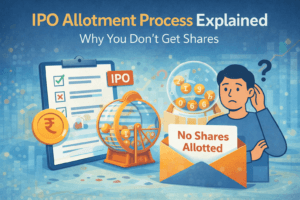
If you have ever applied for an IPO and later checked the allotment status only to see “No shares allotted”, you are not alone. This is one of the most common frustrations faced by new investors in the stock market.
Many beginners assume that applying for an IPO automatically means they will get shares. But in reality, IPO allotment works very differently. Understanding how the IPO allotment process works—and why shares are not always allotted—can save you confusion, disappointment, and unrealistic expectations.
In this article, I’ll explain the IPO allotment process step by step in simple language, discuss why investors often don’t get shares, clear common misconceptions, and share practical tips to improve your chances in future IPOs.
What Is an IPO and Why Is It Important?
An IPO (Initial Public Offering) is the process through which a private company offers its shares to the public for the first time and gets listed on the stock exchange.
Why do companies launch IPOs?
Companies come out with an IPO to:
Raise money for business expansion
Repay loans
Fund new projects
Allow early investors to partially exit
Increase brand visibility and trust
Once listed, the company’s shares can be bought and sold by the public on exchanges like NSE and BSE.
For investors, IPOs are attractive because they offer a chance to invest in a company at an early stage of its public journey.
You can read more about IPO in the stock market and the application process: What Is an IPO in the Stock Market? Meaning, Process & How to Apply
Understanding the IPO Allotment Process (Step by Step)
Let’s break down how IPO allotment actually works, without technical jargon.
Step 1: IPO Opens for Subscription
When an IPO opens, investors can apply for shares during the subscription period (usually 3 working days). You apply through your broker using a UPI-based system.
Step 2: Categories of Investors
Investors are divided into categories:
Retail Individual Investors (RII) – most beginners fall here
Qualified Institutional Buyers (QIB)
Non-Institutional Investors (HNI)
Each category has a fixed portion of shares reserved.
Step 3: Subscription Status
Once the IPO closes, demand is measured. If demand exceeds available shares, the IPO is said to be oversubscribed.
For example:
Retail quota: 1 crore shares
Applications received: 10 crore shares. This means the retail portion is subscribed 10 times.
Step 4: Basis of Allotment
This is the most important step.
When an IPO is oversubscribed, shares are not allotted on a first-come, first-served basis. Instead, a lottery system is used for retail investors.
SEBI rules ensure:
Maximum number of investors get at least one lot
Allocation is fair and random
Step 5: Allotment Finalization
The registrar (such as KFintech or Link Intime) finalises the allotment based on the lottery system.
Step 6: Refund & Listing
If you don’t get shares, your blocked money is released
If you get shares, they are credited to your demat account by the listing or UPI mandate end day.
Why You Don’t Get Shares in an IPO (Main Reasons)
This is the section most beginners care about. Let’s explain it clearly.
1. Heavy Oversubscription
The biggest reason is oversubscription, especially in popular IPOs.
Example:
If 1 lakh investors apply for 10,000 lots, only 10% investors will get shares. The remaining 90% will go empty-handed—even if they did everything correctly.
2. Lottery-Based Allotment for Retail Investors
For retail investors, IPO allotment works like a lottery.
Everyone has an equal chance
No preference for early applicants
No preference for bigger brokers
Even a perfect application can still result in no allotment.
3. Limited Retail Quota
Only a certain portion of shares is reserved for retail investors. Institutional investors usually get a larger chunk, leaving limited shares for the retail category.
4. Applying for Only One Lot
When demand is high, applying for more lots does not guarantee better chances, but applying for just one lot puts you entirely at the mercy of the lottery.
5. Multiple Applications from Same PAN (Rejected)
If you apply multiple times using the same PAN through different brokers or accounts, all applications can be rejected.
6. Technical or UPI Mandate Issues
If the UPI mandate is not accepted on time, your application becomes invalid—even if you applied correctly.
Common Misconceptions About IPO Allotment
Let’s bust some popular myths.
❌ “If I apply early, I’ll get shares”
Wrong. IPO allotment does not depend on timing.
❌ “Big brokers guarantee allotment”
No broker can guarantee IPO allotment.
❌ “Applying at a higher price improves chances”
Retail investors are usually allotted at the cutoff price. Price selection does not increase your chances.
❌ “Applying for more lots guarantees shares”
Not true for retail investors. All valid applications have equal probability.
❌ “Good IPO means sure allotment”
A good IPO usually means higher demand, which actually reduces your chances.
How IPO Allotment Works for Retail Investors (Simple Example)
Suppose:
Retail quota: 1,00,000 shares
Lot size: 10 shares
Total available lots: 10,000
Retail applications received: 50,000
Result:
Only 10,000 investors get shares
40,000 investors get nothing
Selection is random
This is why many genuine investors don’t receive shares.
Tips to Improve Your Chances of Getting IPO Allotment
While there is no guaranteed method, these tips can slightly improve your probability.
1. Apply from Multiple Family Accounts (Legally)
Each PAN has a separate chance. Family members with separate demat accounts can apply individually.
2. Avoid Multiple Applications from Same PAN
Stick to one clean application per PAN.
3. Always Apply at Cut-Off Price
This ensures your application is valid even if the final price is fixed at the upper band.
4. Ensure UPI Mandate Is Accepted on Time
Many applications fail simply because the UPI mandate wasn’t approved.
5. Focus on Less Hyped IPOs
Moderately subscribed IPOs offer better chances than heavily hyped ones.
6. Keep Expectations Realistic
Treat IPO investing as an opportunity, not a guarantee.
Final Thoughts: IPO Allotment Is About Luck, Not Skill
IPO allotment, especially for retail investors, is largely a game of probability. Not getting shares does not mean you made a mistake or chose the wrong IPO.
The key is to:
Understand the process
Apply correctly
Keep expectations realistic
Focus on long-term investing, not just listing gains
Over time, consistency and patience matter far more than one IPO allotment.
Frequently Asked Questions (FAQs)
1. What is IPO allotment?
IPO allotment is the process where shares of a company are given to investors who applied for the IPO. If the IPO is oversubscribed, shares are not given to everyone and are allotted through a lottery system.
2. Why didn’t I get IPO allotment even after applying?
You may not get IPO allotment mainly because:
The IPO was oversubscribed
Too many people applied for limited shares
Allotment is done randomly, not guaranteed
Even if you apply correctly, there is no assurance of getting shares.
3. Does applying for more lots increase IPO allotment chances?
No. In the retail category, applying for one lot or multiple lots gives the same chance. IPO allotment is done on a lottery basis, not on quantity.
4. Is IPO allotment based on first come first serve?
No. IPO allotment is not first come first serve. All valid applications received before the closing date are treated equally.
5. How is IPO allotment done in oversubscribed IPOs?
When an IPO is oversubscribed:
Retail investors get shares via computerized lottery
Minimum one lot is allotted to selected applicants
Remaining applicants get no shares
This is why many investors don’t receive allotment.
6. Can my IPO application be rejected?
Yes. IPO applications can be rejected due to:
Incorrect UPI mandate approval
Wrong Demat details
Multiple applications from the same PAN
Not approving UPI mandate before the deadline
7. What happens if I don’t get IPO allotment?
If you don’t get IPO shares:
Your blocked money is released
No amount is deducted
You can use the funds for other investments
8. How can I check IPO allotment status?
You can check IPO allotment status through:
IPO Registrar website (RTA) like Link Intime, KFinTech
Your broker app (Zerodha, Groww, Angel One)
NSE or BSE website
9. Is IPO allotment guaranteed if IPO is undersubscribed?
Yes, mostly.
If an IPO is undersubscribed, chances of allotment are very high, provided your application is valid.
10. Does IPO allotment depend on luck?
Yes. In oversubscribed IPOs, allotment is purely based on luck, as shares are distributed through a lottery system.
11. Can I apply for IPO from multiple Demat accounts?
No. Applying from multiple Demat accounts using the same PAN is illegal and can lead to rejection of all applications.
12. When will IPO shares be credited to Demat account?
If allotted:
Shares are credited 1 day before listing
You can see them in your Demat account
Trading starts on listing day
13. Does IPO subscription percentage matter?
Yes. Higher subscription means:
Lower allotment chances
More competition
Higher dependence on lottery
14. How can I increase my IPO allotment chances?
You can:
Apply in multiple IPOs
Avoid multiple PAN applications
Ensure UPI mandate approval
Prefer less hyped IPOs
There is no guaranteed trick, but these improve your chances.
15. Why do big investors get IPO shares easily?
Big investors apply under:
HNI or QIB category
They invest large amounts
Different allotment rules apply
Retail investors compete only within the retail category.