What is a Stock Split? (Simple Explanation)
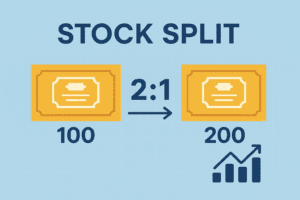
A stock split is when a company increases the number of its shares by reducing the price per share. This does not change your total investment value. You simply get more shares at a lower price.
In other words, a stock split is when a company divides its existing shares into multiple new shares. It does this to make the stock price more affordable and increase liquidity. Even though the number of shares increases, the total value of your investment stays the same.
For example, if a company announces a 2:1 stock split, it means every 1 share becomes 2 shares.
Example: Stock Split with a 2:1 Ratio
Let’s say you have 100 shares of a company priced at ₹1,000 each.
• Total investment = 100 × ₹1,000 = ₹1,00,000
After a 2:1 split:
• Your shares double from 100 to 200
• The price adjusts from ₹1,000 to ₹500
New investment value = 200 × ₹500 = ₹1,00,000
So nothing changes in total value. You simply get more shares at a lower price.
Why Do Companies Do a Stock Split?
Companies announce stock splits mainly for these reasons:
• To make the share price more affordable for retail investors
• To increase liquidity and trading volumes
• To improve market participation
• To give a positive signal of company growth
How Is a Stock Split Different From a Bonus Issue?
Stock Split:
• The number of shares increases
• The price per share reduces
• Face value is reduced
• No new value is created
Bonus Issue:
• New shares are issued free of cost
• Price adjusts based on new total shares
• Face value does not change
• New shares come from company reserves
In both cases, the total investment value remains the same, but the reasoning and mechanics are different.
How Long Does It Take to Receive Stock Split Shares?
Normally, split shares are credited to your demat account within 2–3 working days after the record date.
Until then, your demat may show only your old share count. You can sell the shares that appear in your demat, but you must wait for the remaining split shares to be credited before selling them.
Price Adjustment After Stock Split (Simple Example)
If a stock priced at ₹900 announces a 3:1 split:
• For every 1 share, you now get 3
• Your shares triple
• Price reduces to one-third
If you had 60 shares:
• New share count = 60 × 3 = 180
• New price = ₹900 ÷ 3 = ₹300
• Investment value remains the same = ₹54,000
What Happens to Fractional Shares in a Stock Split?
In some stock splits, your shareholding may result in a fractional quantity (like 0.5 or 0.2 shares). Since fractional shares cannot be credited to your demat account, the company’s Registrar and Transfer Agent (RTA) settles these fractions in cash. The cash amount for the fractional share is directly credited to your primary bank account linked to your demat account. So even though you won’t receive the fractional share itself, you will receive the equivalent value in cash automatically—no action is required from your side.
Important Things to Keep in Mind
• You don’t need to do anything. If you hold shares on the record date, the split happens automatically.
• You don’t gain extra value. The investment value stays the same; only the quantity and price change.
• Don’t buy just because of a split. A lower price doesn’t mean the company becomes better. Always check fundamentals.
• Face value changes, not fundamentals. Only the denomination changes, not the business performance.
• You can sell only credited shares. You may see only your original quantity for a day or two. Wait for full credit before selling additional shares.
Top 10 FAQs on Stock Split
1. What is a stock split?
A stock split is when a company increases the number of its shares and reduces the price per share without changing the total value of your investment.
2. Does a stock split increase my wealth?
No. Your investment value remains the same. Only the number of shares and price per share change.
3. What is a 2:1 stock split?
A 2:1 split means every 1 share becomes 2 shares.
4. Why do companies split their shares?
To make the stock more affordable and increase market participation.
5. What happens to my share price after a stock split?
The price reduces in proportion to the split ratio.
6. How many days does it take to receive split shares in my demat?
Usually, 2–3 working days after the record date.
7. Do I need to apply for the split?
No, it happens automatically if you hold the shares on the record date.
8. Can I sell shares immediately after a stock split?
You can sell only the shares that are already credited in your demat. You must wait for the additional split shares to be credited.
9. Is a stock split the same as a bonus issue?
No. A split divides shares; a bonus issues free new shares from the company’s reserves.
10. Should I buy a stock just because it split?
No. Always review fundamentals. A lower price alone is not a reason to buy.